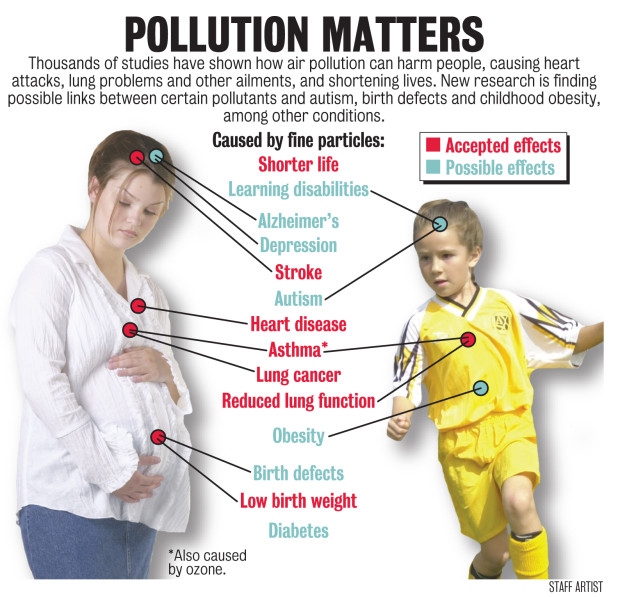
When the British rock group, The Hollies, recorded their hit song, "The Air that I breathe" in 1974, it's doubtful that they were referring to air pollution, but these days air pollution is on the minds of anyone who lives in a large and populated city. When the weather gets warm, air quality alerts are a regular part of the news. These alerts are of particular importance to those who have any type of lung disease, such as asthma, since breathing in the chemicals and particulate matter that makes up air pollution can easily exacerbate such diseases. Other studies show that breathing in polluted air can predispose to both cardiovascular disease and cancer. I think about that whenever I see joggers running next to heavy traffic areas. Ostensibly, such joggers are running to improve their health, but breathing in all the carbon monoxide and other toxins emanating from car exhaust can be the equivalent of smoking a pack of cigarettes in terms of bodily damage and inhalation of toxic chemicals. They would serve themselves better by simply staying at home and riding a stationary bike or using a treadmill. Or better yet, just go to the gym. Surely the gym, being indoors, has much cleaner air compared to outside, doesn't it?
Perhaps not, according to a recent study. This study sought to measure the degree of indoor air pollution at 11 health clubs in Lisbon, Portugal. The gyms there are very similar in the way they are set up here in the United States. As such, they often feature separate rooms for weight training, aerobics, and group exercise classes. A group of researchers from the University of Lisbon and the University of Technology in the Netherlands got permission to set up machines in the gyms that measure the degree of air pollution being emitted. The machines were set up during the late afternoon and evening hours when the gyms are the most crowded. These special machines measured the levels of indoor air pollution for two hours at each of the 11 Lisbon gyms. The indoor pollutants measured included carbon monoxide, the stuff that the outdoor joggers who ran next to cars were breathing, along with carbon dioxide, ozone (which is the main ingredient in smog), and various airborne particulate matter (APM) such as dust, along with chemicals released by carpeting, cleaning products, furniture, paint, and even formaldehyde, used to embalm corpses. The study authors also placed three other monitors in the gym buildings that measured air quality throughout the day.
Most gyms, especially on warmer days, either provide adequate ventilation by keeping windows and doors open or run an air conditioning system that ostensibly filters the air, removing various potentially noxious particulate matter such as dust. So this means that the air in the gyms . . .
Join today and get access to this article and all past and present Newsletters, since September 2014. Each month you’ll get a new issue sent to your inbox. Subscribe today for only $10/month!