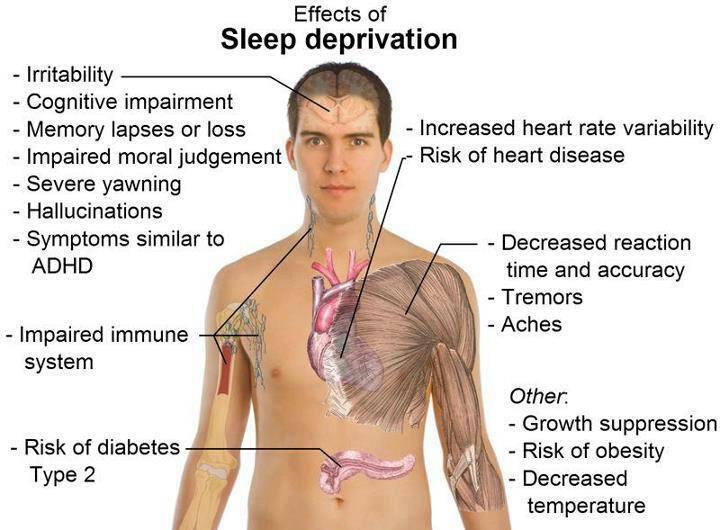
Whether we like it or not, we have to sleep. Consider that if you sleep an average of 8 hours a night, you will have slept 229,661 hours or a third of your life. Many people think that sleep is a waste of time and do everything they can to minimize the time spent sleeping. Such people often claim to feel great on only about 5 hours a night of sleep or even less. In truth, they are just engaging in self-deception that will eventually come back and kick them in their collective butts. Sleep is, without question, essential to health, well-being, and longevity. But as vital as sleep seems to be, the precise reasons why we need sleep still aren't clear, although recent research has shed much more light on why we need sleep (and by the way, exposure to light at night can produce insomnia!). When asked the question, "Why do we need sleep?" William C Dement, M.D, who headed the Stanford University Sleep Medicine Center, and who was considered an authority on sleep having studied it for over 50 years, responded this way: "As far as I know, the only reason we need to sleep that is solid is that we get sleepy." Dement wasn't trying to be sarcastic with his very non-scientific response, but rather expressing the view of most scientists who study the sleep process. Sleep remains a mysterious process about which the full extent of why and what isn't yet known. But we do know a lot about what happens when you lack sufficient sleep.
The maladies shown to be related to insufficient sleep range from diabetes to Alzheimer's disease. Indeed, a complete lack of sleep is downright deadly as shown by what happens to those unfortunate enough to be afflicted with a rare genetic disorder called Fatal Familial Insomnia (FFI). This disease usually shows up during middle-age, about age 50. The cause is a mutation in a gene called PRWP that causes prions to eat away at a structure in the brain called the thalamus. Prions are a type of protein particle that seems to cause disease by promoting the misfolding of other proteins. Prions are also the cause of Creutzfeldt-Jakob disease or CJD. In cattle, this disease is also known as "Mad Cow Disease," and a variant of it has also shown up in humans who may have consumed tainted meat. In those with the genetic disorder, FFI prions inexplicably attack the thalamus. Since the thalamus is involved in several processes that result in sleep onset, eventually those with FFI cannot sleep at all. The prions have poked holes through their brain's thalamus structure, making it look like Swiss cheese. Once the last stage of . . .
Join today and get access to this article and all past and present Newsletters, since September 2014. Each month you’ll get a new issue sent to your inbox. Subscribe today for only $10/month!