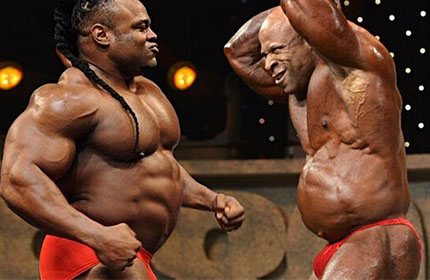
Somehow, the leanest men in the room had the biggest bellies
Beginning in the mid-1990s, a strange new look started showing up on competitive bodybuilding stages. It began among the pros, then filtered down to amateurs and eventually to bodybuilders who never competed. The look was unmistakable: grossly distended, ballooning stomachs on athletes who were otherwise shredded, veiny, and carrying almost no body fat. It made no visual sense — these were some of the leanest men (and a handful of women) in sports, yet their midsections looked swollen, almost pregnant. The illusion held only when they relaxed their abdominal muscles. Flex, and the gut vanished, replaced by a sharp, deep six-pack.
Before the bloat appeared, distended abdomens were essentially unheard of in competitive bodybuilding. I competed from the mid-1960s to the early '70s, and I never once saw a competitor with a bloated gut. Nor did the champions before or after me — going back to the 1940s — ever show that look; all had flat stomachs and sharply developed abdominals. Steve Reeves and Reg Park, who dominated the 1950s, both had trim, tight waistlines with no hint of bloat. Reeves — who later played Hercules in a string of European films — refused to train his abs directly at all, believing the added muscle would thicken his famously tiny 29-inch waist. Park took the opposite approach, building prominent abdominals while keeping his waist small. Decades later, French pro Serge Nubret, a contemporary of Arnold Schwarzenegger, chased the same small-waist, deep-ab combination by training his abdominals daily, sometimes for hundreds of repetitions a session. Three-time Mr. Olympia Frank Zane followed the same high-repetition philosophy.
One problem: they were all chasing a myth. Spot reduction — the idea that working a muscle burns the fat covering it — doesn't hold up scientifically. The body burns fat systemically, not regionally, no matter how many crunches you do. The far more effective route to a lean midsection is diet paired with aerobic exercise, since fat oxidizes most efficiently when oxygen intake is high.
If it wasn't fat, what was it? Surprisingly, more than 30 years after the look first appeared, no definitive study has ever pinned down the cause. The handful of bodybuilders who've undergone abdominal CT scans have shown nothing abnormal — no tumors, no fluid, no organ damage, just an unexplained bulge. That absence of a smoking gun hasn't stopped theories from piling up. Several have been proposed over the years. None has been proven.
Theories about bloated bodybuilding bellies that are wrong
Plenty of theories have been floated to explain bodybuilders' bloat, and most don't survive contact with basic . . .
Join today and get access to this article and all past and present Newsletters, since September 2014. Each month you’ll get a new issue sent to your inbox. Subscribe today for only $10/month!