Like many nutrients and scientific breakthroughs, iodine was discovered by accident. In 1811, French chemist Bernard Courtois stumbled upon the element while producing saltpeter for Napoleon's gunpowder supply. When he added sulfuric acid to the ash of burnt seaweed, a striking dark violet vapor rose from the mixture and crystallized upon contact with cool surfaces. Fellow chemists quickly identified the substance as a new element and named it "iodine," after the Greek word for violet.
The medical significance of iodine emerged just as quickly. By 1813, researchers were proposing that goiter — a common, visible neck swelling — could be treated with seaweed-based preparations. Because seaweed is among the richest natural sources of iodine, scientists began connecting the condition to iodine deficiency, establishing iodine as an essential mineral. What they had not yet grasped, however, was that the body requires it only in trace amounts. Early treatments used far larger doses than necessary, and the excess iodine triggered a paradoxical effect: in susceptible individuals, it overstimulated thyroid hormone production, a phenomenon now associated with the Jod-Basedow effect and the broader condition known as thyrotoxicosis — a state of dangerously elevated thyroid hormone levels. That same risk exists today among those who misuse high-dose thyroid hormone medications in the mistaken belief that artificially elevating metabolism will accelerate body fat loss.
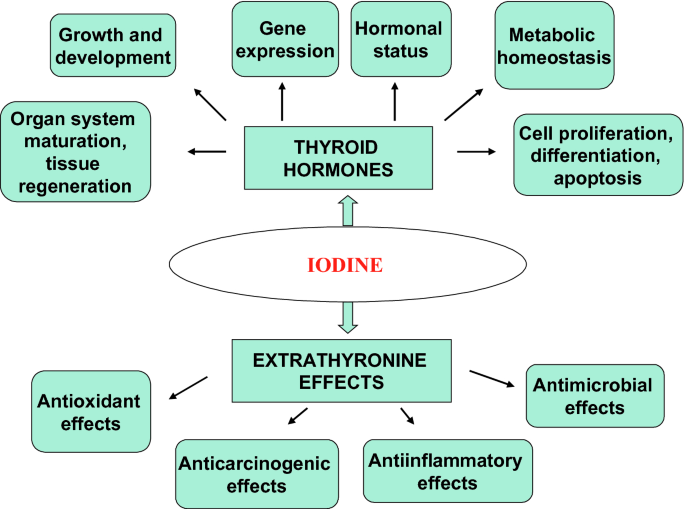
The primary function of iodine is to promote thyroid hormone synthesis since two-thirds of thyroid hormone is iodine, with the other third being the amino acid tyrosine. In the past, iodine deficiency was a significant problem. Similar to vitamin D, the presence of iodine is limited in natural food sources, and if a person doesn't consume foods that contain iodine, such as the following:
- Seafood: Fish like cod, tuna, sea bass, haddock, and perch are rich in iodine. The amount of iodine in fish can vary depending on whether it was wild-caught or farm-raised and where it was caught. Shellfish and shrimp are also good sources.
- Seaweed: Kelp, nori, kombu, and wakame are good sources of iodine.
- Dairy: Milk, yogurt, and cheese contain iodine, but the amount varies depending on whether the cows were fed iodine supplements and if iodophor sanitizers were used to clean the cows and equipment.
- Eggs: Eggs are a good source of iodine.
- Iodized salt: Table salt with added iodine is the primary food source of iodine in the United States and many other . . .
Join today and get access to this article and all past and present Newsletters, since September 2014. Each month you’ll get a new issue sent to your inbox. Subscribe today for only $10/month!